I met
Peter Lerangis at this year’s
Allen County Young Author’s program. I was very impressed by his humorous author presentations, his friendly and spunky personalty, and his ingenious writing skills. So glad I met ya, Peter!
Here are some selections taken from his
biography:
“Peter Lerangis is the author of more than 160 books, which
have sold more than 5½ million copies and been translated into 33 different
languages. Seven of his books have made the New York Times–Children’s
Bestseller Lists:
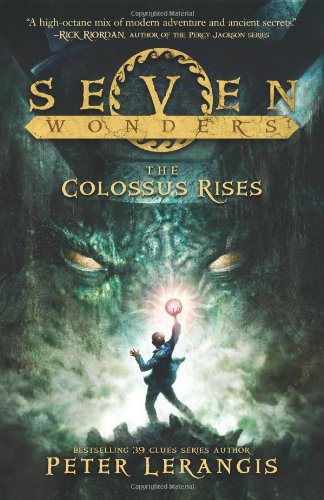
The Colossus Rises,
Lost in Babylon, and
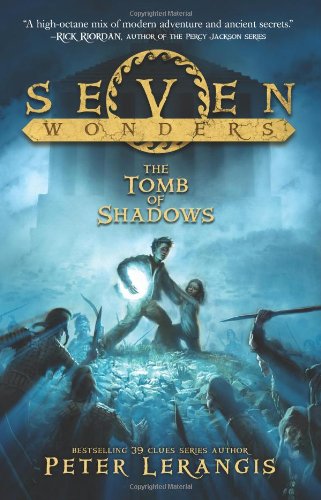
The Tomb of Shadows, Books 1 through 3
of
The Seven Wonders series;
The Sword Thief,
The Viper’s Nest, and
Vespers Rising (the latter
co-authored with Rick Riordan, Gordon Korman, and Jude Watson) in
The 39 Clues series;
and
The Dead of Night, Book 3
in
The 39 Clues: Cahills Vs. Vespers series.
His novel
Somebody,
Please Tell Me Who I Am, a collaboration with Harry Mazer, won
the
2013
Schneider Award…
“Peter was one of three authors, along with R. L. Stine and
Marc Brown, invited by the White House to represent the U. S. in the
first
Russian
Book Festival in 2003…
“He is a Harvard graduate with a degree in biochemistry.
After college he became a Broadway musical theater actor. He has run a marathon
and gone rock-climbing during an earthquake, but not on the same day. He lives
in New York City with his wife, musician
Tina deVaron,
and their two sons, Nick and Joe.”
_________________________________________________________________________________
Through my correspondence with him, I asked Peter some questions about his writing and his reading history:
1. What inspired you
to become a writer?
I don’t remember ever not wanting to be one!
As the oldest kid in a big extended Greek-American family who all lived pretty
close together, I was the go-to caregiver for a huge gaggle of siblings and
cousins. They looked up to me, and I enjoyed entertaining them with imitations,
stories, and jokes. So in a way, I grew up as a storyteller. And
when I was old enough to write, my favorite thing to do was to hole up in my
room with the door firmly shut and a pad of paper on the desk. I would
lose myself for hours letting my ideas spill out onto the page. It was
almost an out-of-body experience! I was an unathletic, bookish kid, and
writing made me feel expansive and powerful.
2. What was the first
book that inspired you to become an avid reader?
My parents read to me every night when I was little. I
distinctly remember my favorites: Ferdinand, Millions of Cats, One
Fish Two Fish, To Think That I Saw It on Mulberry Street. When
I was old enough to read, I started with Dr. Seuss but quickly became a fan of
science fiction, mystery, and books about precocious animals. I raced
through the Tom Swift adventures and the Freddy the Pig series.
I was a huge fan of superhero comics, which are essentially extended serial
fiction. My dad loved to see my growing avidity, and he was the one who
took the time to drive me to the library every week so I could check out
books. He took great pride in the armfuls I’d bring home, and he always
gave the OK for my unreasonably large purchases from the Scholastic Book
Clubs. To this day, I love seeing dads involved in their kids’ reading
lives—particularly sons—because I so looked up to my own dad as a role model.
3. Which authors have
inspired your writing?
I didn’t realize it as I was growing up, but in my own way,
I was carefully studying the revolutionary imagination of Ted Geisel, the
over-the-top suspense and sensual language of Edgar Allan Poe, the boundless
imagination of Ray Bradbury, and the earthiness of Jack London. At age
eleven or so, while reading London’s story To Build a Fire on a
sweltering summer night, I started shivering with cold. This floored me –
that the prose itself had the power to create a physical change like that, with
words alone. I thought then that if I could ever do that for others, it
would be the coolest way to make a living. From that point on I began
expanding my reading into all kinds of fiction, literary and popular, all the
while trying to suss out exactly how the author achieved that power – what kind
of words they used to tease out character and ideas, what kinds of things they
held back.
4. What made you base
a series on the seven wonders of the ancient world?
Basically the idea was borne of three failed ideas that
coalesced over years into something pretty exciting.
First, the Wonders. One of the great highlights of my
honeymoon in Greece was a romantic dinner on the harbor in Rhodes. Of
course, everyone there points out the location of the ancient Colossus astride
the entrance, but I realized it would have been physically impossible to have
built a monument of that size. I began becoming interested in the Seven
Wonders—how were they built, why were they so wonderful, why seven? etc. but
never thought of myself as a nonfiction writer.
Second, Atlantis. While in Crete, we heard stories of
the sunken island, which the Cretans believe existed off their northern
coast. Well, there are many areas in the world that claim Atlantis, and
all my life I was fascinated by the story. But thousands of people had
tackled that topic! What could I possibly add to it?
Third, years ago I tried hard to pitch a series based on the
idea of The Prisoner, a sixties-era TV series about a man trapped against
his will on a mysterious island as part of a scientific/political
experiment. I wanted to involve a group of kids – but for the life of me,
I couldn’t figure out why on earth they would be there. So I put that
aside too.
One day, somehow I put these three things together—and
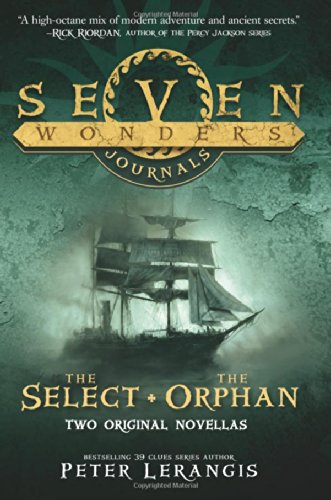
everything clicked. Seven Wonders is about a team of four kids
with a powerful genetic condition inherited from a prince who escaped the
sinking of Atlantis—a condition that promises to magnify each kid’s greatest
talent into a superpower, but also kill them by the age of 14. They find
themselves on the secret island home of an institute that has found a cure: if
these kids can return to the island seven magic relics stolen centuries ago
from Atlantis and hidden in the Seven Wonders of the Ancient World, they will
be cured. And, unbeknownst to them, they will also save the world from destruction.
5. For people who are
trying to become writers, what advice would you give them?
1. You have to want it more than anything else in the world.
You have to be the kind of person who doesn’t settle for no.
2. Reading voraciously — all the time — is the single best
training to become a writer.
3. It helps to be intensely curious about how your favorite
authors make their work so good. What kind of words do they use? What kind of
words do they leave out?
4. You need to practice. Like a musical instrument or a
sport, writing gets better with constant work. Write some things for yourself,
pieces that no one else sees. Also write stories that you show to people you
respect — teachers, librarians, parents, siblings, other authors, etc. Listen
to their feedback. Learn to recognize useful and useless feedback. Useful
feedback is your best friend, even though it may feel painful.
5. You must collect ideas. Write them down. A pad or a
writer’s notebook is great, but anything will do, even a receipt or a scrap of
paper. Collect your ideas from conversations, things you observe in everyday
life, dreams, other books and movies, etc. When you have a bunch of them, read
them over and decide which is the best. Which one makes you the most excited?
Start working on that one. If you like it, chances are your readers will too.
6. You need to recognize that the stakes in your story must
be super-high. Even in stories about everyday life, there must be some dilemma
that seems impossible to solve, something the readers will hang on to until the
very end. Every story is a mystery. What do you don’t reveal, how
you don’t reveal it, and how honestly you lead the reader to the revelation, is
the writer’s job. That’s what will pull your readers in.
7. Live life to the fullest. It’s easier to write compelling
stories if you’ve experienced compelling events in your life.
8. Don’t worry about getting published right away. I
like to think that everything I write is the worst thing I will have written
from now till the day I die—which is another way of saying I assume that I will
improve with each story. Writers must understand that often it is the
fourth of fifth or twelfth work, not the first, that is ready for prime-time.
9. Did I say practice?
 Drucilla Overbey thinks she’s found a home with the Putnam
family. However, her loving expectations sour when Dru notices Ann Putnam's
obsessive and paranoid behavior. Meanwhile, a new minister moves into town with
the Barbados slave, Tituba. Soon many of the local girls, like Dru, secretly visit
Tituba to have their fortunes told. But when the minister’s daughter becomes
oddly lethargic, the other girls mimic her behavior to cover their interactions
with Tituba. Their strange stupor ignites Ann Putnam’s paranoia, causing her to
accuse community members of witchcraft. Again, to cover their tracks, Dru and
the girls go along with her false accusations. But when Dru’s friend is accused of witchcraft, it's up to Dru to stop the maddness the Salem
witch trials.
Drucilla Overbey thinks she’s found a home with the Putnam
family. However, her loving expectations sour when Dru notices Ann Putnam's
obsessive and paranoid behavior. Meanwhile, a new minister moves into town with
the Barbados slave, Tituba. Soon many of the local girls, like Dru, secretly visit
Tituba to have their fortunes told. But when the minister’s daughter becomes
oddly lethargic, the other girls mimic her behavior to cover their interactions
with Tituba. Their strange stupor ignites Ann Putnam’s paranoia, causing her to
accuse community members of witchcraft. Again, to cover their tracks, Dru and
the girls go along with her false accusations. But when Dru’s friend is accused of witchcraft, it's up to Dru to stop the maddness the Salem
witch trials.